High-Contrast White/Yellow on Black Surfaces & 1.2 mm Precision
Two demanding coding tasks require specialized CIJ fluidics: opaque pigmented marking on dark substrates (black polyethylene conduit, automotive rubber hoses, dark beer/soy glass bottles, PCBs) and 1.2 mm micro-character marking on tiny electronic components, vials, and thin wire insulation. Inside continuous inkjet printers and industrial inkjet printers, dedicated 40–50 μm micro-nozzle heads and continuous pigment-agitation tanks solve both cleanly.
Unlike dye molecules that dissolve completely, opaque white and yellow pigments consist of suspended solid TiO2 particles that settle if left un-circulated—so dedicated pigmented CIJ cores run periodic gentle stirring even during overnight standby.
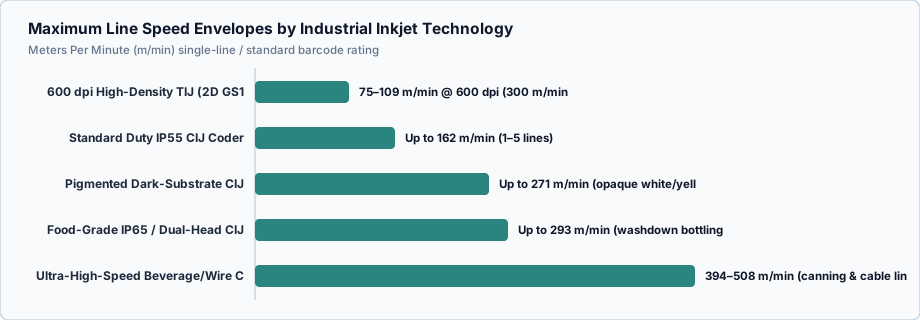
Pigmented Contrast CIJ vs Micro-Character HR CIJ Specs
Compare the two specialized small-character CIJ variants:
| Parameter | Pigmented Contrast CIJ (1710 / 1580C) | Micro-Character HR CIJ (1880HR Class) |
|---|---|---|
| Nozzle Orifice Size | 60–75 μm clog-resistant orifice | 40–48 μm precision micro-orifice |
| Character Height Window | 2.0 – 10.5 mm bold opaque strokes | 1.1 – 1.2 mm up to 6.5 mm ultra-crisp |
| Max Linear Line Speed | Up to 271 m/min (888 ft/min) | Up to 394 m/min (1,292 ft/min) |
| Fluid Management | Conical tank + automated standby agitation | High-frequency drop generator for tiny 2D codes |
| Target Applications | Black pipe, wire/cable, dark glass, tires | SMD electronics, 2 ml ampoules, thin catheters |
See full wire-and-pipe encoder setups in pharma and extrusion coding.
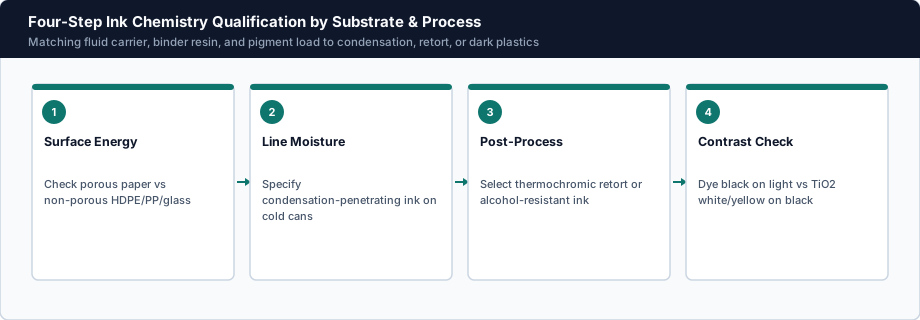
Industrial Coding Engineering Notes
- Zero Settling Over Weekend Shutdowns: Leaving pigmented CIJ plugged into AC standby lets automatic 15-minute stir cycles keep white TiO2 homogeneous without wasting a drop of solvent.
- Plasticizer-Migration Resistance on PVC Cable: Flexible PVC wire insulation exudes plasticizers that smear standard inks when coiled warm—specify non-transferring cable-grade pigmented MEK.
- Readable 4×4 mm DataMatrix on Vials: Micro-character 40 μm nozzles place crisp 2D DataMatrix squares onto 12 mm vial caps and watch batteries.
Test White or Yellow Contrast on Your Dark Sample
Ship 1 meter of cable/pipe or 5 dark bottles via Project Brief for a contrast test.
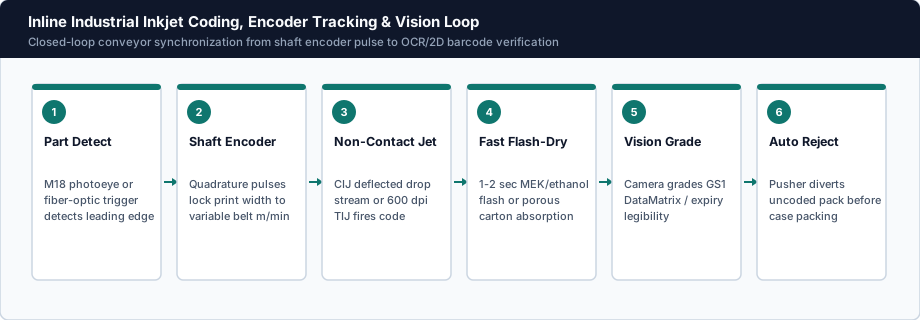
Explore related coding platforms in Industrial Inkjet Printers, Inks, Solvents & Print Specs, or send your substrate & belt m/min via Project Brief.