Why Conveyor Linear Speed (m/min)—Not BPM—Determines Print Quality
A bottling line running just 60 bottles/min can easily run its conveyor belt at 45 meters/min to create bottle spacing—and printing a 3-line lot/expiry + 2D QR code requires 3× higher drop frequency than printing a single 5-dot line! Built on inkjet coding inks and specs, use our calculators and TCO guides before choosing between CIJ, TIJ, or laser.
Calculate exact belt speed and encoder pulses in our coding line speed calculator and check adhesion in the substrate-to-ink compatibility chart, then read industrial inkjet printer price & TCO, CIJ vs TIJ vs laser selection guide, and our inline integration & FAT checklist.
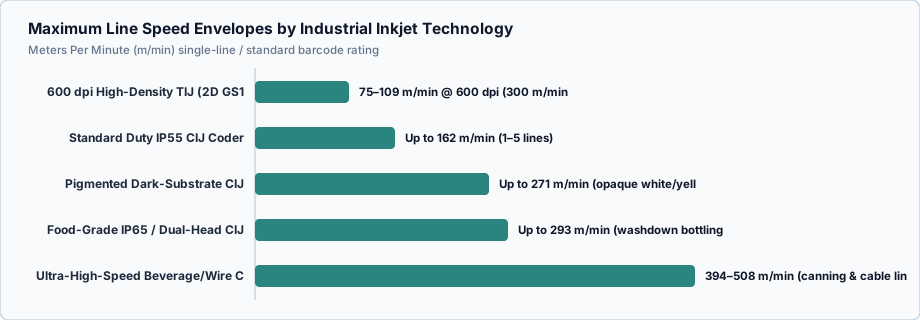
Single-Line vs Multi-Line CIJ Speed De-Rating Guide
Notice how adding text lines or 2D matrices changes maximum linear belt speed on a 293 m/min CIJ coder:
| Message Format | Vertical Dot Matrix | Max Linear Belt Speed | Max Cans/Min (@ 100 mm pitch) |
|---|---|---|---|
| 1 Line High-Speed Date | 5 or 7 dots high | Up to 293 m/min | Up to 2,900 cans/min |
| 2 Lines (MFG + EXP + Lot) | 7 + 7 dots (16-dot) | Up to 146 m/min | Up to 1,460 cans/min |
| 3 Lines Full Traceability | 7 + 7 + 7 dots (24-dot) | Up to 81 m/min | Up to 810 cans/min |
| 2D GS1 DataMatrix + 2 Lines | 16×16 or 24×24 matrix | 45–95 m/min | 450–950 packs/min |
Explore matching printer families in industrial inkjet printers.
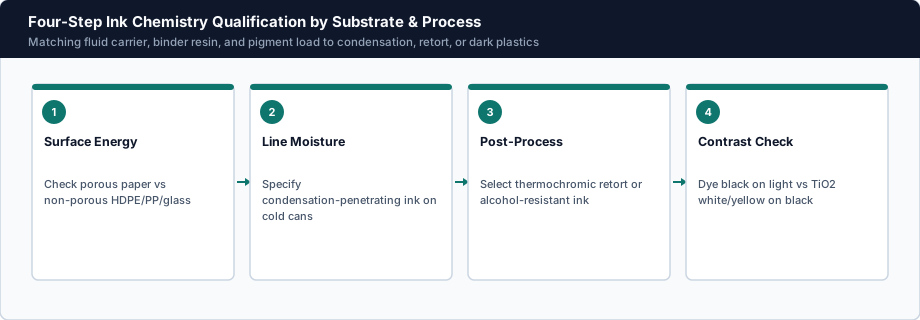
Industrial Coding Engineering Notes
- Vibration Isolates Printheads: Mount printhead stands directly to the floor (isolated from vibrating VFFS or punch presses) so 1.2 mm micro-characters never wave.
- Evaluate 5-Year Consumable TCO: A $2,000 TIJ coder using 12 cartridges/year has a very different 5-year cost curve than a $6,500 CIJ running 2 million cans/month on bulk 1L ink.
- Verify Barcode Grade >= B (1.5): Retail and pharma GS1 2D specifications require ISO/IEC 15415 print quality >= Grade C/B across full production speed.
Run a 5-Year Cost & Speed Check
Share your annual pack volume, lines of text, and belt m/min via Project Brief.
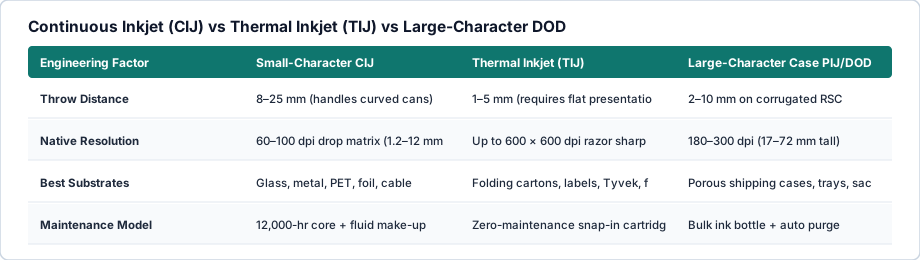
Explore related coding platforms in Industrial Inkjet Printers, Inks, Solvents & Print Specs, or send your substrate & belt m/min via Project Brief.
In This Section
- BPM to Linear Belt Speed (m/min) & Encoder Pulse Calculator
- Packaging & Industrial Substrate to Inkjet Technology & Ink Lookup Chart
- Industrial Inkjet Printer Price Guide & 5-Year Consumable TCO Math
- Continuous Inkjet (CIJ) vs Thermal Inkjet (TIJ) vs Laser Marking Compared
- Inline Inkjet Mounting, Encoder Calibration & Barcode FAT Checklist
Related Specifications
Further Reference
- Industrial Inkjet Ink Chemistry, Dry Times & Printhead Specifications
- BPM to Linear Belt Speed (m/min) & Encoder Pulse Calculator
- Packaging & Industrial Substrate to Inkjet Technology & Ink Lookup Chart
- Industrial Inkjet Printer Price Guide & 5-Year Consumable TCO Math
- Continuous Inkjet (CIJ) vs Thermal Inkjet (TIJ) vs Laser Marking Compared