Why Ink Carrier Chemistry Governs Adhesion, Dry Time & Compliance
Across industrial inkjet printers, hardware is only half of the engineering equation: an ink formulated for porous kraft cartons sits wet for minutes on BOPP snack film, while standard MEK dye ink vanishes completely on black polyethylene conduit. Industrial coding inks balance volatile carrier solvents (MEK, ethanol, ethyl acetate, or water), polymer adhesion resins, and dye vs mineral pigment loads.
On modern condenser-equipped CIJ frames, volatile make-up fluid consumption drops as low as 2.4 ml/hour at 20 °C—cutting annual VOC emissions and consumable OPEX in half compared with older uncooled cabinets.
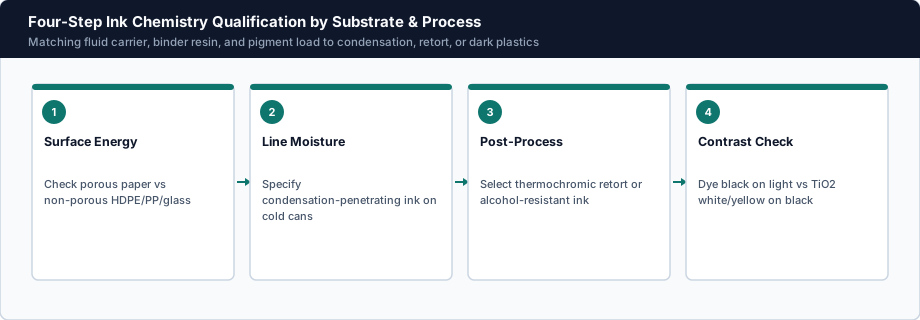
Industrial Coding Ink Chemistry by Substrate & Environment
Select carrier fluid and colorant class for permanent rub-resistant legibility:
| Ink Formulation Class | Dry Time | Target Substrates | Special Process Performance |
|---|---|---|---|
| Fast-Dry MEK Dye (CIJ) | 1–2 seconds | PET, BOPP, aluminum cans, glass, foil | General high-speed primary packaging |
| Condensation-Penetrating MEK | 1–2 seconds | Cold-filled beer/soda cans & dairy bottles | Cuts through thin moisture film without halo |
| Ketone-Free / Ethanol Food-Grade | 2–4 seconds | Food pouches, pharma blisters, egg shells | Low-odor, FDA/EU direct or indirect food grades |
| Opaque Pigmented TiO2 (CIJ) | 2–3 seconds | Dark amber glass, black PE pipe, cables, rubber | High contrast white, yellow, sky-blue, silver |
| Solvent / Hybrid TIJ Cartridge | 2–4 seconds | Varnished cartons, glossy labels, Tyvek, foil | 600 dpi crisp edges on semi-/non-porous webs |
| Thermochromic Retort Ink | 1–2 seconds | Autoclaved pouches, tinplate food cans, jars | Shifts black -> blue/red to confirm sterilization |
Look up your exact material in our substrate-to-ink compatibility chart.
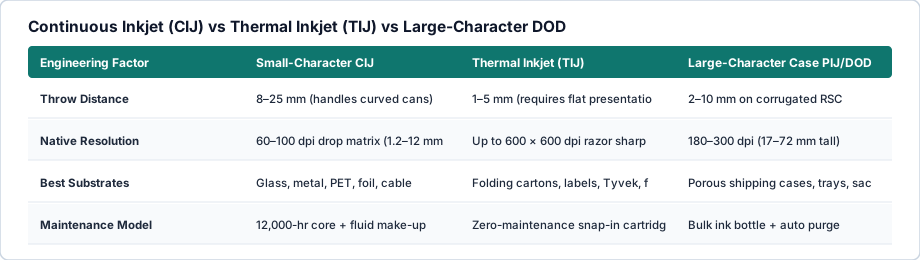
Industrial Coding Engineering Notes
- Low-Surface-Energy Polyolefins (PP / HDPE): Untreated HDPE detergent jugs (~30 dynes/cm) require adhesion-promoted ketone or specialty polyolefin TIJ inks so codes resist thumb-rub and alcohol wipes.
- Caustic Returnable-Bottle Washable Inks: Returnable glass beverage bottlers specify alkali-soluble inks that stay rock-solid in ice buckets yet dissolve 100% clean in warm caustic bottle washers.
- Shelf Life & Agitation on Pigmented Inks: Titanium dioxide (TiO2) white pigments are 4× denser than solvent—always pair pigmented inks with dedicated agitated-gutter CIJ cores (never standard dye printers).
Request Free Substrate Sample Coding
Explore industry setups in packaging coding applications and sizing tools in coder sizing and selection.
Send sample pouches, caps, or extrusions via Project Brief.
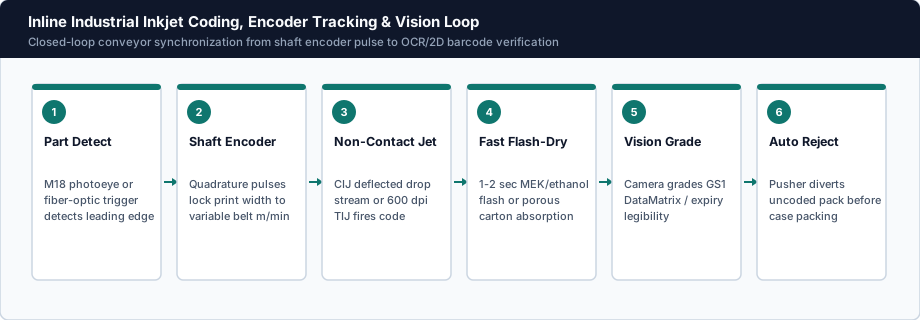
Explore related coding platforms in Industrial Inkjet Printers, Inks, Solvents & Print Specs, or send your substrate & belt m/min via Project Brief.