Choosing objectively Across the Big Three Industrial Coding Technologies
Procurement teams frequently ask whether to standardize on Continuous Inkjet (CIJ), Thermal Inkjet (TIJ), or Laser Marking (CO2 / Fiber / UV). None of the three wins everywhere: lasers have zero ink cost yet require $15,000–$35,000 guarded enclosures + fume extractors and can perforate thin flexible snack films if mis-tuned; TIJ has zero maintenance and 600 dpi acuity yet cannot jump a 12 mm gap onto a curved jar; CIJ marks virtually anything at 300+ m/min yet consumes solvent make-up. Built within coder sizing and selection and inkjet coding inks and specs, compare all three objectively.
Many high-efficiency plants standardize on CIJ for primary bottles/cans/pouches and TIJ or Piezo for secondary cartons/cases.
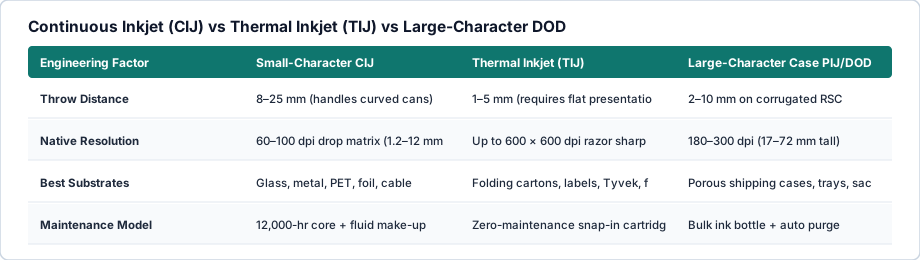
CIJ vs TIJ vs Laser Side-by-Side Decision Matrix
Evaluate technical capability and shop-floor constraints:
| Decision Criterion | Continuous Inkjet (CIJ) | Thermal Inkjet (TIJ) | CO2 / Fiber / UV Laser |
|---|---|---|---|
| Throw Distance / Curvature | 8–25 mm (excels on curved/recessed) | 1–5 mm (flat surfaces only) | Focal-lens window (curved needs 3D) |
| Print Resolution | 60–100 dpi drop matrix | 600 × 600 dpi native | Crisp vector / permanent etch |
| Substrate Universal Fit | Universal (swap ink color/chemistry) | Cartons, labels, flat films, foil | Substrate-specific wavelength! |
| Thin Film Puncture Risk | Zero (non-thermal drop) | Zero | High on thin mono-films if mis-set |
| Safety Guarding & Fumes | Ventilated area (low-VOC condenser) | None (clean cartridge) | Class 1 interlocked enclosure + carbon fume unit |
| Upfront Hardware Cost | $2,600 – $11,500 | $650 – $4,800 | $9,500 – $35,000+ |
Prepare your conveyor installation with our inkjet integration and FAT checklist.
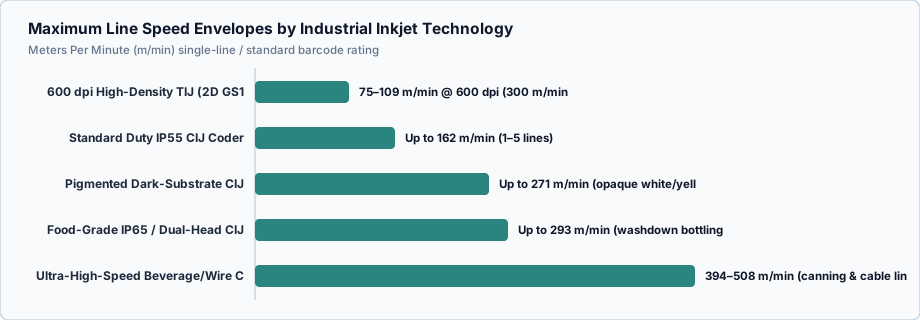
Industrial Coding Engineering Notes
- Multi-SKU Substrate Flexibility Favors CIJ: A contract packager switching from clear PET Monday to dark amber glass Tuesday and foil pouches Wednesday can run one CIJ—whereas CO2 laser etches glass/paper poorly on bare metal and fiber laser misses clear PET.
- Cleanroom Pharma Cartons Favor TIJ: Zero VOCs, zero fume dust, and native 600 dpi Grade-A DataMatrix make TIJ the cleanroom favorite on folding cartoners.
- Over-10M Single-SKU PET/Carton Lines: Dedicated 24/7 mineral-water or clay-carton lines running one substrate for 5 years can justify laser capex—everywhere else, CIJ + TIJ win on agility.
Ask for a Side-by-Side Sample Print Comparison
Send your actual packaging samples via Project Brief.
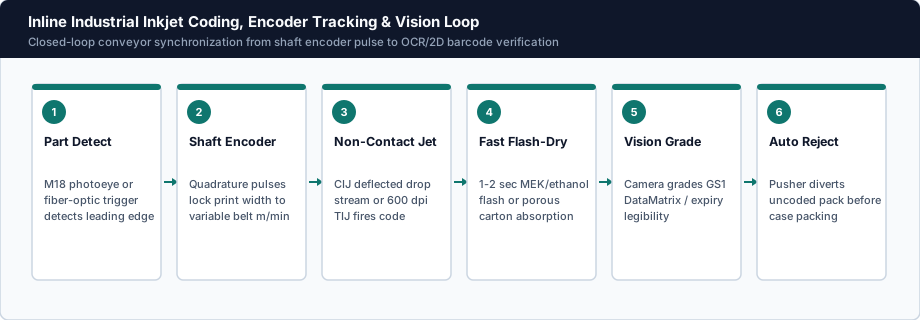
Explore related coding platforms in Industrial Inkjet Printers, Inks, Solvents & Print Specs, or send your substrate & belt m/min via Project Brief.