Eliminating Wavy Text, Missed Triggers, and Smudged Codes on Day 1
Ninety percent of ‘printer quality issues’ reported after installation are actually mechanical mounting or trigger defects: clamping a printhead arm to a vibrating shaker chute, mounting the encoder on a slipping idler roller, or letting glossy cartons double-trigger an un-polarized photoeye. Grounded in coder sizing and selection and inkjet coding inks and specs, walk through this five-point checklist during commissioning.
Complete all five checks before signing off line readiness.
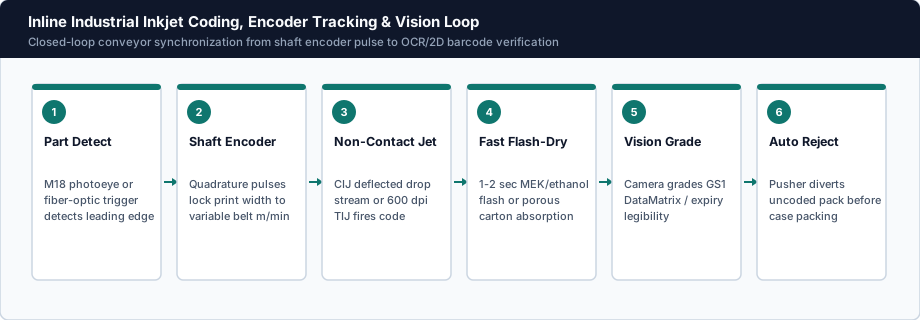
Five-Point Inkjet Commissioning & FAT Protocol
Mechanical, electrical, and print-quality acceptance standards:
| Verification Check | Test Procedure | Pass Acceptance Standard |
|---|---|---|
| 1. Bracket Vibration & Standoff | Run host machine at 100% speed; measure nozzle gap | Independent floor stand; gap steady within ±0.5 mm (TIJ) / ±2 mm (CIJ) |
| 2. Variable-Speed Encoder Test | Ramp conveyor VFD from 20% -> 100% -> 40% mid-run | Printed code width stays identical (±0.3 mm) across all speeds |
| 3. Trigger Debounce & Pitch | Feed 500 glossy/dark packs; check print registration | Zero double-prints or missed packs; ±1.5 mm placement |
| 4. Adhesion & Rub-Dry Audit | Thumb-rub at 2 sec + cross-hatch tape + cold sweat test | Zero ink transfer; 100% legible after cold-chain moisture |
| 5. ISO Barcode Verification | Scan 50 consecutive 1D/2D codes on verifier | 100% Grade B (1.5) or higher; fault relay stops host on empty |
See complete turnkey cells on inline coding and vision integration.
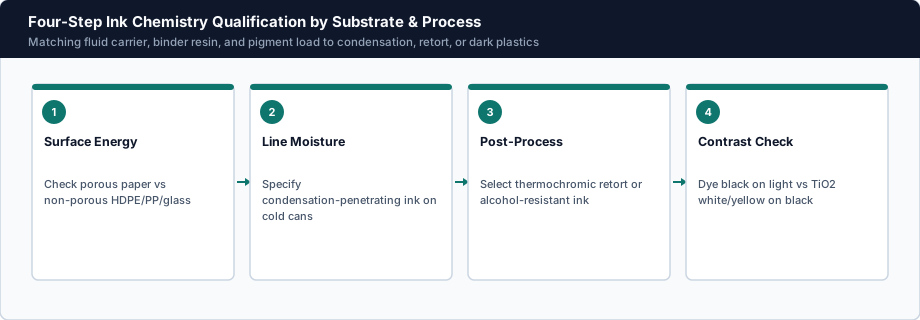
Industrial Coding Engineering Notes
- Ground Stainless Printhead Stands Properly: Static buildup on fast-unwinding BOPP film webs can deflect charged CIJ droplets—bond the printhead bracket and conveyor frame to clean earth ground!
- Use Polarized Retro-Reflective or Background-Suppression Sensors: Shiny foil pouches fool cheap diffuse photoeyes; use background-suppression laser/LED sensors set to exact pack distance.
- Keep 1 Spare Cleaning Bottle & Nozzle Wipe Kit at the Line: A 30-second weekly faceplate inspection keeps CIJ gutters and TIJ cartridges spotless.
Schedule Sample Qualification & Bracket Review
Submit conveyor photos and coding specs via Project Brief.
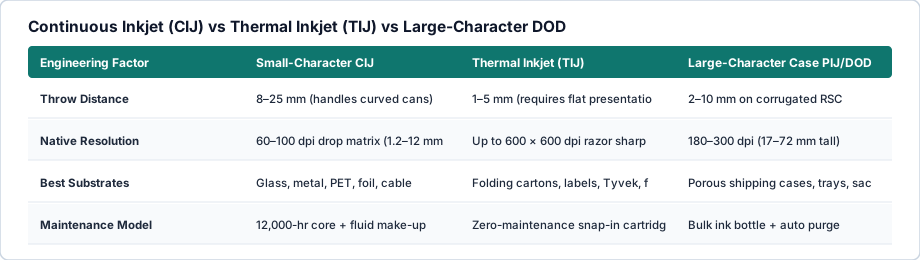
Explore related coding platforms in Industrial Inkjet Printers, Inks, Solvents & Print Specs, or send your substrate & belt m/min via Project Brief.